


Telling whether a stylus is worn starts with your ears, but it shouldn’t end there. Sibilance and distortion can also come from dirt, wrong tracking force or a worn record, so rule those out before you look at the tip under real magnification.
Key takeaways
- Harsh “s” sounds, distortion near the label and dull treble are the classic signs.
- Clean the stylus and check tracking force before blaming wear.
- A loupe can’t show wear; you need real optical magnification and side lighting.
The sounds of a worn stylus
- “S”, “sh” and “t” sounds turn splashy or spitty, especially on vocals.
- The end of each side, near the label, distorts more than the start.
- Cymbals and strings lose their top end, as if a filter were on.
- Loud passages that used to play cleanly start to mistrack.
- The record has more surface noise than it used to.
None of these proves the stylus is worn, only that something in the playback chain needs attention, and the usual turntable setup checks come first.
Two of them are worth telling apart. Inner-groove distortion grows towards the label, where the groove speed is about half that at the rim, and usually points to tracking or alignment; sibilance can appear anywhere on a side if a record is cut hot. Wear also creeps in slowly: one owner who measured a 2M Blue stylus with about 400 hours against a new one found the new one up to 5 dB brighter around 15 kHz, though the old one still looked and sounded fine.
Rule out the look-alikes first
| Symptom | Worn stylus? | Other common causes | Quick check |
|---|---|---|---|
| Sibilance on vocals | Yes, typical | Dirty stylus, tracking force too low, poor alignment, worn record | Clean stylus, check force, try a reference record |
| Worse distortion near the label | Yes, typical | Alignment off at the inner null point, record pressed badly | Check alignment with a protractor |
| One channel distorts more | Possible (uneven wear) | Anti-skate wrong, azimuth off | Check anti-skate, then azimuth |
| Skipping | Late-stage wear or damage | Tracking force too low, anti-skate too high, bent cantilever, warped record | Check force, inspect cantilever |
| Dull treble | Yes, gradual | Phono stage capacitance too high, cartridge loading | Compare on another phono input if possible |
| Fuzzy, dull sound after a few minutes | Rarely | Dust ball on the stylus | Look at the tip; clean it |
Records cause more of this than most people expect. Collectors on one forum found the same sibilance on the same tracks across several stereo pressings of a classic 1960s album, while the mono version was clean, so the problem was cut into the record. When alignment checks out, a stylus fitted slightly crooked on its cantilever is another possible cause, and on conical DJ cartridges a better-tracking cartridge can make sibilance disappear.
Before you buy a new stylus, clean it properly and check the tracking force; both cost nothing and rule out the two commonest look-alikes.
The 10-minute listening test
- Pick a reference record in good condition with clear vocals near the end of a side.
- Clean the record and the stylus.
- Check tracking force with a gauge and set anti-skate to match.
- Play the last track of the side and listen to the “s” sounds and the cymbals.
- Play the same track from a stream or CD. If the “s” sounds are harsh there too, the master is the cause.
- Compare by playing the same track on another turntable, or with a new stylus, if you can.
If the problem persists on a clean reference record at the correct force, and moves with the stylus to another deck, the stylus is the cause.
Looking at the tip: how much magnification you need
A diamond tip is a fraction of a millimetre across, and the wear flats that matter measure a few thousandths of a millimetre. That is why a 10× loupe shows only dirt or a broken tip, not wear.
- Around 200×: owners report that wear flats become clearly visible at about this magnification, but only if it is optical, not digital; many cheap USB microscopes advertise figures they reach by digital zoom.
- Light from the sides: lighting matters as much as magnification. The Shure SEK-2 stylus microscope lit the tip from left and right; owners copy it with two LED lamps at about 45°, or one lamp and a mirror.
- The right kind of microscope: biological microscopes light the sample from below and have too little depth of field; a stereo, dissection or metallurgical microscope works better. Owners have built working setups from an old microscope bought for $10 to $100 plus two lamps.
- 600×: the magnification at which classic wear studies photographed stylus contact areas.
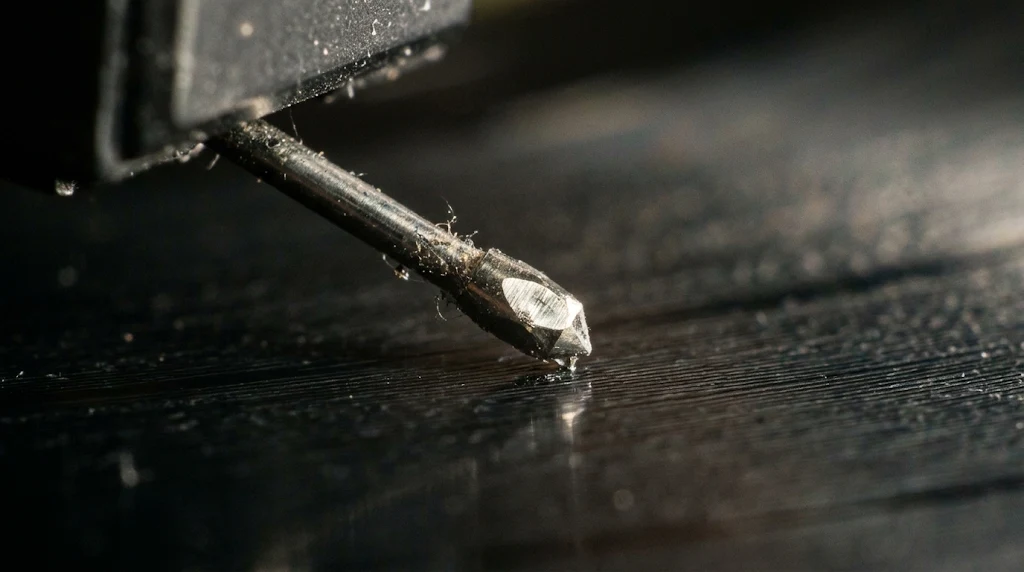
- What to look for: with side lighting, a healthy elliptical tip shows two small bright spots at its contact points. On a worn tip they have grown into two flat facets that almost meet in the middle; a damaged one shows chips or a missing diamond. Shibata and other fine-line tips can look “worn” this way even when new, so compare with a reference picture of the same tip shape.
- Also check the cantilever: it should be straight and centred, not bent sideways or pushed up into the body.
Key numbers
~8 dB
Rise in second-harmonic distortion after 200 hours on a stylus rated for 1,000 hours
Community wear study (SWS3)
~14 dB
The total rise at 672 hours, when the study stopped because the test records were damaged
Community wear study (SWS3)
~3 dB at 14 kHz
The treble loss estimated for a 6 µm wear flat, with about 1% distortion
Pspatial Audio wear review
Myth vs fact
Myth: A worn stylus gets blunt at the point, so you can see it with a magnifying glass.
Fact: The tip wears flat at its two contact points on the groove walls, not at the point; the flats are a few thousandths of a millimetre wide and need side lighting and real magnification to see.
A worn stylus doesn’t only sound bad; its flat edges wear the groove walls of every record it plays. How fast is disputed: some say a well-aligned worn stylus makes itself heard before it does serious damage, while Microlinear owners warn that their tips sound the same until the very end, by which time the damage has started. Once you’ve heard the signs and ruled out the look-alikes, stop playing valuable records until the stylus is replaced.
If you bought a used turntable
It is impossible to know how many hours an unknown stylus has played, so combine a listening test with a visual check, or simply replace it before playing valuable records; a new stylus for most popular cartridges costs less than a few new LPs. A stylus that looks new after decades in a drawer says nothing about its hours either. If you do not own a microscope, ask a local hi-fi repair shop: owners report shops that still inspect styli for a small fee, or none.
For a Microlinear or similar tip, sound is the wrong test: count hours. Owners keep a simple tally, for example a click counter pressed for every LP side and divided by three for hours, and replace around 500 hours to stay safe.
Summary
Listen for sibilance, inner-groove distortion and dull treble, then rule out a dirty stylus, wrong tracking force, poor alignment and worn records with a clean reference record. Confirm with real optical magnification and side lighting rather than a loupe. Wear can appear well before the rated hours, so trust the test rather than the calendar.
Frequently asked questions
Can you see stylus wear with a magnifying glass?
Not reliably. A loupe shows dirt and breakage; wear flats need far stronger optical magnification and side lighting.
Can I tell if my stylus is worn from a phone photo?
Usually not. Owners who inspect styli say most phone photos show only whether the tip is dirty or the diamond is missing; wear needs side lighting and real optical magnification.
Can a worn stylus damage records?
Yes. Its flattened edges wear the groove walls, which is permanent.
Does a worn stylus cause skipping?
Late-stage wear or damage can, but skipping is more often caused by low tracking force, wrong anti-skate or a warped record.
How long does a stylus last?
Makers quote from a few hundred to a few thousand hours depending on the tip and care; listen and inspect rather than relying on the number.
Sources (5)
- Pspatial Audio: Stylus wear and lifetime, summary of published wear studies (2020, verified 11/2026). pspatialaudio.com/stylus_wear.htm
- Headphonesty: report on the SWS3 community stylus wear study of the AT-VM95ML (June 2026, verified 11/2026). www.headphonesty.com/2026/06/study-catches-vinyl-stylus-carving-records/
- Ortofon: When to replace the stylus of your phono cartridge (no date, verified 11/2026). ortofon.com/blogs/news/when-to-replace-the-stylus-of-your-phono-cartridge
- Phoenix Audio Community Forums: How do you determine when to replace a stylus? (January 2022, verified 11/2026). forums.phxaudiotape.com
- Fluance: When should you replace your turntable stylus (support article, verified 11/2026). support.fluance.com