



Automatic vs Manual Turntable Guide: The choice between an automatic and a manual turntable comes down to whether you let the deck place and lift the tonearm for you, or do it by hand for more control. The difference that matters most in the long run isn’t just convenience, but also what you can adjust, upgrade and repair later. This guide, part of our turntable reviews, compares fully automatic, semi-automatic and manual decks on how they work, what goes wrong, what they let you change and what they cost.
Key takeaways
- Fully automatic decks lower and return the arm at the push of a button; owners who switched to one often say they play records more often, especially with children, housework or limited hand movement.
- Auto mechanisms rarely break outright; they drift: the arm sets down outside the record or lifts early, and on older decks hardened grease on plastic gears is the usual cause, fixed with the service-manual adjustment and fresh grease.
- Semi-automatic decks lift the arm and stop the motor at the end of a side, and a third of owners in the debate call this the best compromise; an add-on arm lifter does the same for a manual deck.
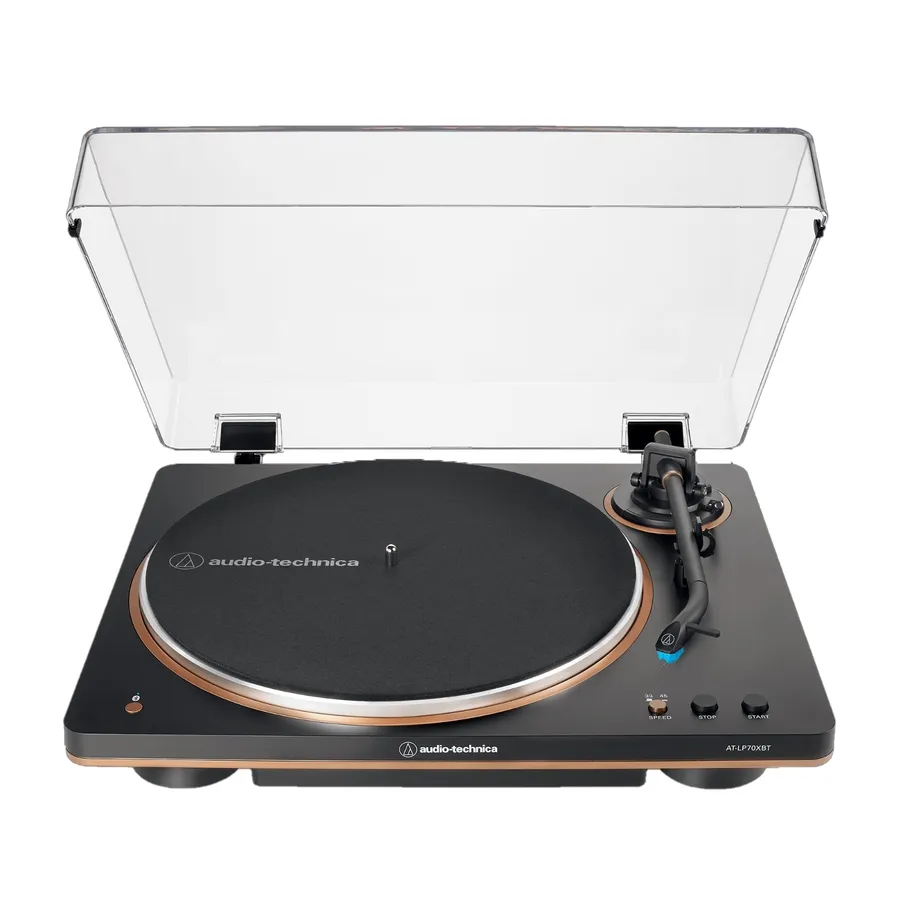
- Many automatic decks have an integrated cartridge, so the only upgrade is a better stylus: on the AT-LP70X that runs from $32 to $199.
- Price for price, a manual deck usually gives you more adjustability; most of today’s good full automatics are vintage, and some records with short run-outs or odd sizes can’t be played fully on an automatic.
Automatic vs manual turntable: the three levels
- Fully automatic: you press start, the platter spins, the arm moves to the lead-in groove and lowers itself. At the end of the side it lifts, returns to its rest and the motor stops.
- Semi-automatic (auto-lift and auto-stop): you place the arm yourself, but at the end of the side the deck lifts it and stops the motor. Some, like the Denon DP-400, let you switch this off. A simpler variant, auto-stop only, stops the platter but leaves the arm in the run-out.
- Manual: you lift and lower the arm with the cue lever and return it to the rest yourself. If you walk away, the stylus keeps riding the run-out groove until you come back.
What each type lets you adjust
| AT-LP70X | AT-LP3XBT | Denon DP-400 | AT-LP120XUSB | |
|---|---|---|---|---|
| Operation | Fully automatic | Fully automatic | Semi-automatic (auto-lift, auto-stop, switchable) | Fully manual |
| Drive | Belt | Belt | Belt | Direct |
| Cartridge | Integrated AT-VM95C | AT-VM95C on universal headshell | Pre-mounted | AT-VM95E on universal headshell |
| Arm setup | None needed (no balancing) | Not stated by maker | Adjustable counterweight and anti-skate | Adjustable counterweight and anti-skate |
| Upgrade route | VM95 stylus only | Stylus or whole cartridge on headshell | Cartridge (fixed headshell) | Stylus or whole cartridge on headshell |
| Price (US) | $249 to $269 | $299 | $599 | $399 |
The AT-LP70X needs no balancing or cartridge installation, which is precisely why it suits a first deck, and also why the only upgrade is the stylus. The Denon DP-400 shows that semi-automatic doesn’t have to mean simplified: it keeps an adjustable counterweight and anti-skate, though its headshell is fixed.
Owners add two practical points. Some cheap automatics drop the stylus quite hard, so owners start the platter automatically but lower the arm themselves with the cue lever. And several entry automatics have no tracking-force adjustment at all, which rules out cartridges that need a different force.
Example
Worked example: An AT-LP70X at $249 with the top AT-VMN95SH Shibata stylus at $199 costs $448. An AT-LP120XUSB at $399 is fully manual, already has an AT-VM95E, takes the same VM95 styli and can take any standard-mount cartridge later. If you plan to upgrade beyond the first stylus, the manual deck is the cheaper route; if you never will, the automatic saves you $150.
What goes wrong with automatic mechanisms
Owners with years on automatic decks describe the same few faults, and most are adjustments rather than breakdowns:
- The arm sets down outside the record or misses the lead-in, often after a move or on a used deck. One owner’s deck arrived from a dealer dropping the needle just off the edge; on another, movers knocked the set-down point out.
- The arm returns too early, before the last track ends, usually after someone has tampered with the return mechanism.
- The mechanism freezes or misbehaves on decks 30 to 45 years old, because the original grease on the small plastic gears has hardened. One used deck drove its arm straight into the centre spindle until it was cleaned and regreased; on another, a return gear had cracked with age.
- Download the service manual for your exact model; it shows the lead-in and return adjustment screws.
- Turn the set-down screw a little at a time and test after each turn, until the stylus lands in the lead-in groove.
- Adjust the return point the same way if the arm lifts before the end of the side.
- Clean off the old grease and relubricate the gears with a grease safe for plastics if the mechanism is stiff or stalls.
- Don’t force the arm by hand while the mechanism is moving; let the cycle finish or use the stop button.
Watch out
Don’t clean automatic mechanisms with WD-40 or similar sprays. Owners warn that they can attack the plastic gears; use a plastic-safe cleaner and grease.
How often do these faults happen? Owners genuinely disagree. Many run 30 to 45 year old Technics, Dual, Sony and Pioneer automatics with no trouble, and one restorer who has worked through about a dozen 1970s decks found that around four in five needed nothing on the auto-return; dirty speed controls and worn belts were the commoner faults. Others say the auto mechanism is exactly what failed on their decks. Both point to the same advice: if you buy a vintage automatic, choose one that has been serviced.
Records an automatic can’t handle
Auto mechanisms work out where a record ends from the position of the tonearm, so some records confuse them:
- Short run-out grooves: the deck lifts the arm before the music ends, or never detects the end. One owner with 800 to 900 LPs had early lifting on only two of them.
- Odd sizes: 5-inch, 10-inch and 11-inch records may not start at the right point, and clear vinyl can fool a size sensor.
- Unusual cuts: records that play from the inside out, locked grooves and hidden tracks in the run-out, which an automatic cuts off.
On decks with auto-lift, this is often adjustable. A Technics SL-1500C owner describes a switch on the back that turns auto-lift off, and a setting in the service mode that moves the lift point closer to or further from the spindle; moving it out cures late lifting but can make records with very little dead wax lift early.
Who switched, and why
The discussion between owners is less about sound than about how they live with records.
- Manual to automatic: owners who made this move often say they listen to vinyl more. One stacked records on a serviced changer while cooking, instead of stopping to flip sides with raw-meat hands; others mention falling asleep, children, family members who use the deck, and physical limits such as arthritis, shaky hands or a bad shoulder.
- Automatic to manual: owners who went the other way value fewer parts to fail, a better deck for the money and the ritual of placing the needle; one who traded a vintage semi-automatic Dual for a manual Pro-Ject says he could not be happier.
- The middle ground: the largest group ends up with semi-automatic or auto-stop: place the needle yourself, let the deck lift it and stop at the end.
At the same new price, owners largely agree a manual deck gets you a better arm, plinth and speed stability, because the money goes into the playback parts instead of the mechanism. Most of the good full automatics they recommend are vintage.
Myth vs fact
Myth: leaving the stylus in the run-out groove for a while ruins it.
Fact: It adds a little stylus wear for no music, but minutes or even a night in the run-out won’t cause problems on a well set-up deck. The worst run-out damage owners post comes from cheap all-in-one players with very high tracking force.
Adding auto-lift to a manual deck
If you want a manual deck but not the run-out risk, owners use add-on arm lifters that sit beside the platter and raise the arm when it reaches the end of the side:
- Audio-Technica AT6006R: a riser with a trigger wire. Very light tonearms may not push the trigger hard enough; owners fixed this by setting the trigger low and in line with the arm.
- Q-Up and Little Fwend: mechanical lifters, from about $40 according to owners; the Q-Up has to be reset by hand each time.
These lifters raise the arm but don’t stop the platter. A deck with built-in auto-lift and auto-stop, such as the Technics SL-1500C, does both.

Tip
Test any lifter on a few records with short run-outs before you rely on it. Owners report that success varies with the record, and some lifters work only most of the time until the trigger position is tuned.
Who should choose which
- Choose fully automatic if the turntable is for a shared room, children, someone with limited hand movement, or mostly background listening; consider a serviced vintage automatic for better build at the same price. Our Pro-Ject Automat A1 review and AT-LP60X review cover two automatic decks at different prices.
- Choose semi-automatic if you want manual control at the start of a side but protection against the run-out groove. See our Denon DP-300F review for a Denon automatic owners recommend as a first deck.
- Choose manual if you plan to change cartridges, want to set tracking force and anti-skate yourself, play odd-sized or unusual records, or want the widest choice of decks at a given price. Our guide to how to set tracking force shows the setup takes 10 minutes.
Summary: Automatic vs Manual Turntable
In the automatic vs manual turntable choice, automatic decks trade adjustment and upgrade room for convenience, and owners who switch to them tend to play more records. Their mechanisms tend to drift rather than break, and most faults are fixed with an adjustment screw and fresh grease, though some records with short run-outs or odd sizes trip them up. Semi-automatic decks and add-on arm lifters give manual control with protection at the end of the side, and manual decks give the most room to grow. If the first cartridge is the last one you will ever use, an automatic is the easier buy; if you plan to upgrade, a manual or semi-automatic deck usually costs less over time.
Automatic vs Manual Turntable: FAQ
Do automatic turntables sound worse?
Not inherently, but at the same price more of the budget goes into the mechanism, and many entry automatics can’t take a better cartridge. The cartridge and setup usually matter more than the automation.
Why does my automatic turntable miss the record or return early?
The set-down or return point has drifted. Most decks have adjustment screws described in the service manual; on older decks, hardened grease in the mechanism can also be the cause.
Can I add auto-lift to a manual turntable?
Yes. Add-on lifters such as the Audio-Technica AT6006R or a Q-Up raise the arm at the end of the side, though they don’t stop the platter.
Can I upgrade the cartridge on an automatic turntable?
On some. Decks with a universal headshell, like the AT-LP3XBT, can take another cartridge; decks with an integrated cartridge, like the AT-LP70X, take only a better stylus.
What is a semi-automatic turntable?
One you start by hand that lifts the arm and stops the motor at the end of a side.
Sources (5)
- Audio-Technica: AT-LP70X fully automatic belt-drive turntable, features and VM95 styli prices. www.audio-technica.com/en-us/at-lp70x
- Audio-Technica: AT-LP120XUSB product page, fully manual operation. www.audio-technica.com/en-us/at-lp120xusb
- Audio-Technica: AT-LP3XBT product page. www.audio-technica.com/en-us/at-lp3xbt
- Audio-Technica: AT6006R safety tonearm lifter. www.audio-technica.com/en-us/at6006r
- Turntable Lab: Denon DP-400, AT-LP70X and AT-LP120XUSB prices and features. www.turntablelab.com
