



You change phono stages, keep the same cartridge, and the treble changes with it. On one stage the cymbals and “s” sounds have more edge, on another the top end sounds softer. It’s tempting to put that down to the phono stage’s sound, but with a moving magnet cartridge there’s often a simpler cause: capacitance.
A moving magnet cartridge is a coil
A moving magnet cartridge makes its signal in a coil with a lot of inductance, typically several hundred millihenries. That coil doesn’t work alone. It meets everything wired after it: the tonearm wiring, the cable to your phono stage, and the phono stage’s own input. Each of those has capacitance, and together with the coil they form a resonant circuit. The standard 47 kΩ load damps it, but where the resonance lands depends on the total capacitance.
Take a cartridge with an inductance of around 500 mH. With 200 pF of total capacitance, the resonance sits near 16 kHz, high enough that most of the audible treble is left as the designers intended. Double the capacitance to 400 pF and it drops to about 11 kHz. Around the resonance the response rises a little, and above it the treble falls away. Pull that rise down to 10 or 11 kHz and you hear it as extra bite on cymbals and sibilants, with less air above it. That’s the “brighter” phono stage, and sometimes the duller one too.
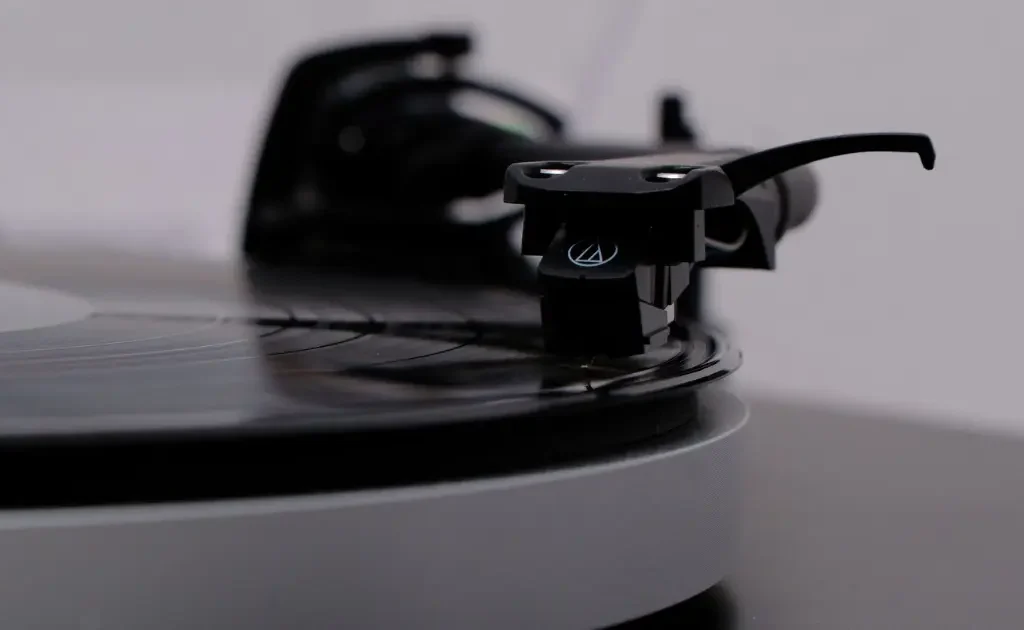
Cartridge makers voice their designs for a capacitance range and publish it. Ortofon gives 150 to 300 pF for the 2M range. Audio-Technica gives 100 to 200 pF for the VM95 series. Inside that range, the cartridge sounds the way its designers intended.
Where the capacitance comes from
Three things add up:
- The tonearm wiring and the cable to the phono stage. An ordinary phono cable often runs around 100 pF per metre, and low-capacitance designs half that or less.
- The phono stage’s input. Many sit between 100 and 220 pF, and some let you choose.
- Anything else in the path, such as an extension cable or a switch box.
Here is how quickly it adds up. An Audio-Technica VM95E with about 150 pF from the tonearm wiring and 1.5 m of ordinary cable together, into a phono stage with 220 pF at its input, sees 370 pF. That’s 170 pF over its recommended 200 pF. Swap to a lower-capacitance cable, about 75 pF for wiring and cable together, and set the phono stage to 100 pF, and the total drops to 175 pF, back inside the range. Same cartridge, same records, a different top end.
A 2M Blue on that first setup would also be over, but by less, since Ortofon’s range runs up to 300 pF. The 2M family simply tolerates more capacitance than the VM95 series, which is worth knowing when you choose a cartridge for a turntable with a long captive cable.
How to check your own setup
You need three numbers:
- The cartridge’s recommended load capacitance. It’s on the spec sheet, usually as “load capacitance”.
- The cable’s capacitance. Good cables list it per metre, so multiply it by your cable’s length. If yours doesn’t, assume around 100 pF per metre for an ordinary one.
- The phono stage’s input capacitance. It’s in the manual, and adjustable stages list each setting.
Add the cable and phono stage figures together and compare the total with the cartridge’s recommended range. If you’d rather not do the sums, our free phono capacitance calculator adds them for you, compares the total with the maker’s figure and shows what it does to the treble.
What to do about it
If you’re over:
- Use a shorter or lower-capacitance cable between the turntable and the phono stage.
- Choose a lower capacitance setting on the phono stage, if it has one.
- If you’re buying a cartridge for a turntable with a long fixed cable, pick one that tolerates more capacitance.
If you’re under, it’s usually less audible. Some phono stages let you add capacitance, and a small step up can bring the response closer to how the cartridge was voiced.
Moving coil cartridges have far less inductance, so capacitance barely matters for them. The exception is a moving coil cartridge running through a step-up transformer, where the transformer multiplies the capacitance of the phono stage’s input and of the cable after the transformer, by the square of its turns ratio, before the cartridge sees it. The calculator has a mode for that too.
So before you decide a phono stage is bright or dull, add up the capacitance. It takes five minutes with three spec sheets, and it’s often the whole story.
