


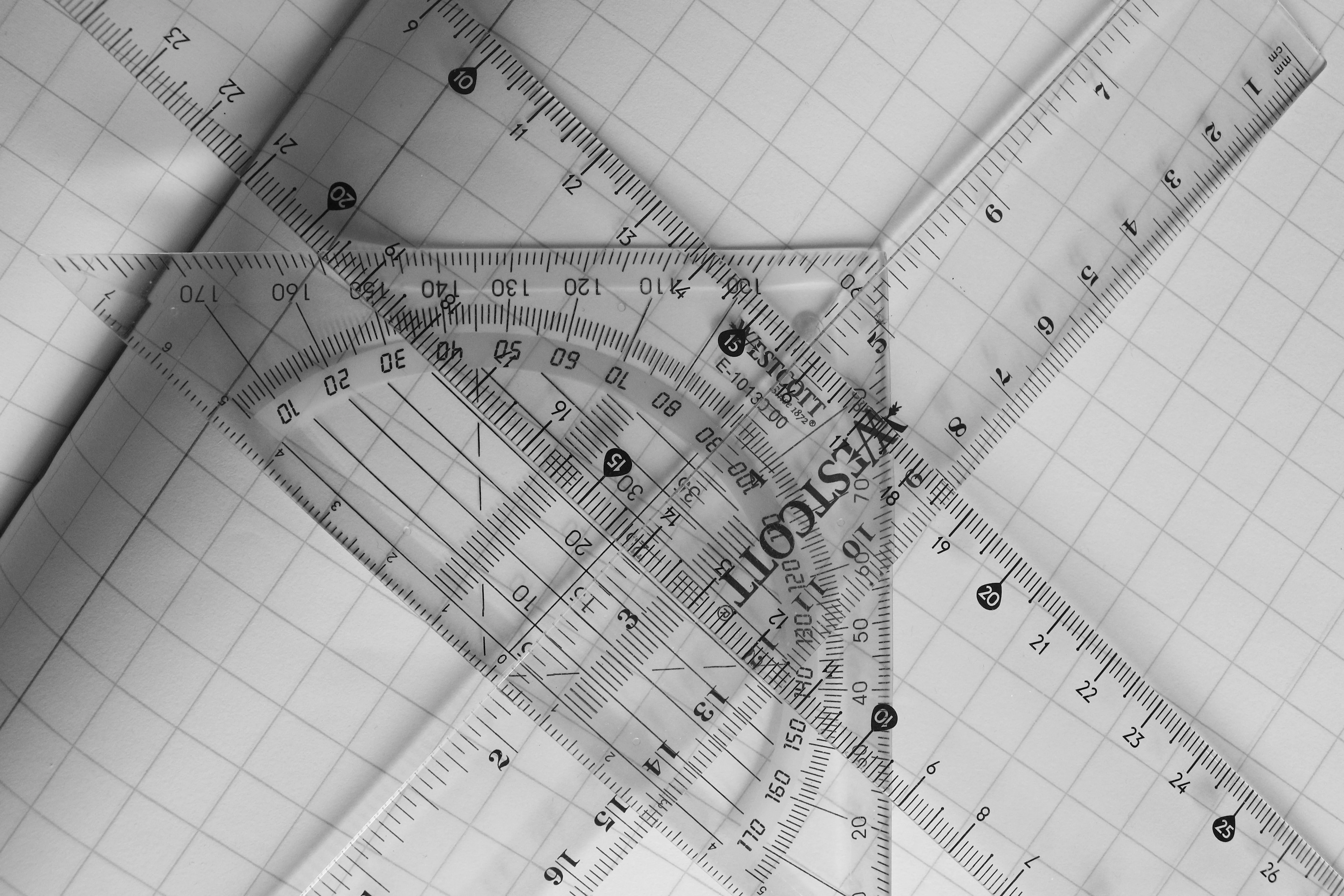
A cartridge alignment protractor is the template you use to set the cartridge’s position in the headshell so the stylus sits as close to tangent to the groove as the tonearm allows. When exploring the Best Cartridge Alignment Protractors on the market, you will find options ranging from a free printout to machined aluminium tools at $150, and the right choice depends less on price than on your tonearm and the alignment geometry you want. This guide, part of our turntable wiki, compares the main types and current models, and explains what the numbers on them mean.
Key takeaways
- For most people, a free printable or a $11 to $20 two-point mat is enough, as long as it matches your arm and prints at true scale: owners describe wrongly scaled printouts that made both null points impossible to match.
- The geometry matters more than the tool: Baerwald, Löfgren B and Stevenson put the two null points in different places and spread distortion differently across the record.
- Check the arm range and the arm’s own geometry: the AT-CAP1 ($17) is made for arms of 222 to 250 mm effective length, and owners found one third-party Rega protractor set to 17.5 mm overhang where current Rega arms specify 14.5 mm.
- Arc protractors such as the Pro-Ject Align It DS3 ($99) trace the whole arm arc and need the pivot-to-spindle distance; they suit people who change cartridges often.
- A protractor sets overhang and offset only; tracking force, anti-skate and azimuth are separate steps.
Types of cartridge alignment protractor
- Two-point protractor (mat or card): a template over the spindle with two marked null points and grid lines. You check that the cantilever is parallel to the lines at both points. The cheapest and most common type.
- Arc protractor: draws the stylus’s path for a given pivot-to-spindle distance, so you set overhang on the arc and offset at the null points. Needs your arm’s mounting distance.
- Tangency checker: lets you check alignment at any radius rather than only two points.
- Arm-specific tools: some makers supply a gauge for their own arm; follow it when you have one. Technics owners use the factory 52 mm overhang gauge, and Fluance and Pro-Ject publish their own overhang figures (about 15 to 16 mm on Pro-Ject tables).
Owners who have used both main types tend to prefer an arc protractor for finding the overhang. On a two-point mat, an overhang error shows only as a tiny angle at one null point, which is hard to see; on an arc, the stylus either follows the line or it does not.
Alignment geometries and their null points
| Geometry | Inner null point | Outer null point | What it favours |
|---|---|---|---|
| Baerwald (Löfgren A) | 66.0 mm | 120.9 mm | Lowest and equal peak distortion across the whole record |
| Löfgren B | 70.3 mm | 116.6 mm | Lower average distortion, slightly higher at the inner and outer edges |
| Stevenson | 60.3 mm | 117.4 mm | Lowest distortion at the end of the side, where inner grooves are most demanding |
None of these is wrong. Baerwald is the default on most two-point mats, including the AT-CAP1, which uses Baerwald. Choose Stevenson if your records are mostly full-length LPs that suffer at the end of the side.
Owners choose based on their collection and their arm. One with 300 LPs and five singles picked Löfgren A for the lowest distortion over a full LP; another kept Technics’ factory setting because he plays 45s, the case Stevenson was designed for. Technics’ 52 mm overhang sits close to Stevenson on DIN groove radii, and Rega’s published arm data also follows Stevenson on DIN or JIS radii, while most other makers set their arms up for Baerwald.
Classical listeners add that a loud finale near the label is the hardest passage to track, which is another argument for Stevenson. One limit applies before any choice: with a fixed headshell whose offset cannot be twisted, you are held to the arm’s stock geometry.
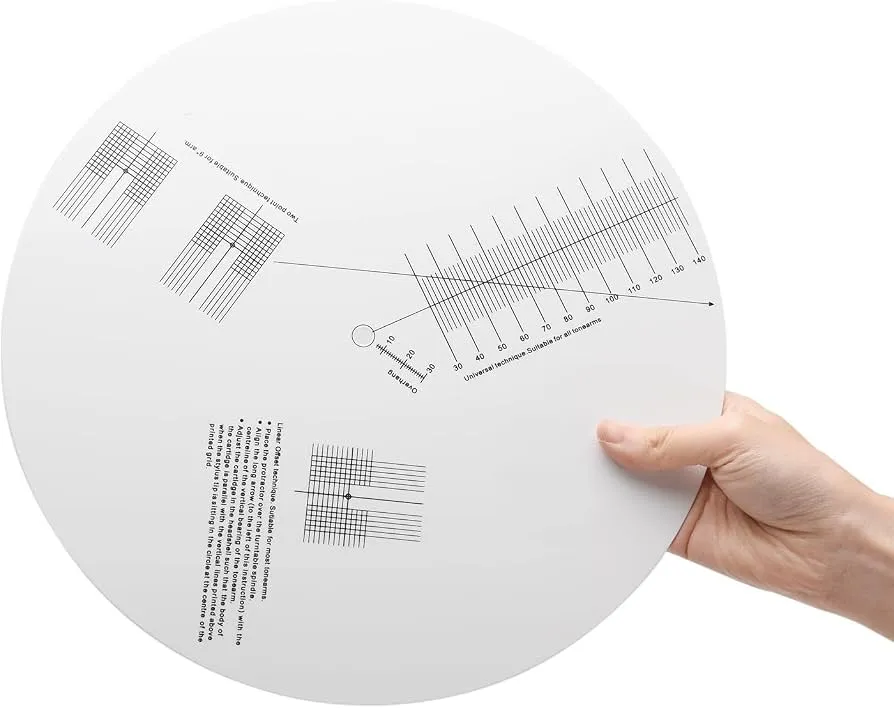
Current protractors compared
When curating a list of the Best Cartridge Alignment Protractors, reviewers evaluate tools across multiple price points and formats.
| Tool | Type | Geometry | Notes | Price (US) |
|---|---|---|---|---|
| Free printable generator | 2-point, arc or linear offset | Baerwald, Löfgren B, Stevenson, custom | Choose geometry, groove standard and arm data; scaling correction included | Free |
| Ortofon Premium Alignment Tool | 2-point card | not stated | Compact card | $10.99 |
| Turntable Lab Alignment Tool | 2-point | not stated | Dual alignment points | $12.95 |
| Audio-Technica AT-CAP1 | 2-point | Baerwald | Arms 222 to 250 mm effective length | $17 |
| LP Gear Precision Mirror Protractor | 2-point, mirrored | not stated | Mirror helps avoid parallax | $19.98 |
| DB Systems Protrac | Tangency checker | any point | Checks tangency anywhere from 44 to 153 mm | $65 |
| Pro-Ject Align It DS3 | Arc | Baerwald, Löfgren B, Stevenson | Pivot-to-spindle 200, 212, 238 and 291.6 mm; no need to rotate the platter | $99 |
| Nerve Audio CAP | Precision grid | Dennison | Arms 8 to 12 in; machined aluminium | $149.99 |
The free generator produces two-point, arc and linear offset protractors and asks for the groove standard and, for arc types, your arm’s pivot-to-spindle distance, overhang and offset angle.
Above $150, owners of precision tools compare them mainly on how well they locate the arm’s pivot. Users who moved from a disc-type arc tool say sighting the pivot along its ridge was the hard part, with an error of about 2 mm on some arms; a precision protractor with a pin over the pivot made that step faster, though one owner found play in the pin’s hole. Among several premium tools, opinions split on which is most precise for the cartridge itself, and one long-time owner of three such tools rates a made-to-order arm-specific arc protractor above all of them, as long as you specify the alignment you want.
Which one to choose
Deciding on the Best Cartridge Alignment Protractors for your specific audio setup depends heavily on your budget and technical preferences.
- First setup, standard arm: a free printable or a $11 to $20 mat. Check that it fits your arm’s effective length.
- Frequent cartridge swaps, or more than one turntable: an arc protractor like the Align It DS3, or a free arc printout made for each arm.
- Want to verify, not just set: the Protrac checks tangency at any radius, which shows how far off an existing setup is.
- Integrated or P-mount cartridge: you do not need a protractor; the position is fixed by the mount. Owners note the downside: if a P-mount deck shows inner-groove distortion, alignment cannot fix it.
- A Rega arm: generate a free arc protractor from the arm’s own data (for the RB880, owners quote 222 mm pivot-to-spindle, 14.5 mm overhang, 21.55° offset) or choose Baerwald knowingly, rather than relying on a ready-made Rega protractor with a different overhang.
- A new turntable with a pre-installed cartridge: check it anyway. Owners say factory alignment is often hurried, and checking it would answer many inner-groove distortion complaints.
Watch out
A printout is only accurate if it prints at 100%. Measure the scale bar or the distance between the null points before you use it; a few percent of scaling moves the null points by millimetres and defeats the point of aligning. Owners who got it wrong describe the symptom: the inner null point lined up but the outer one never did, however they rotated the cartridge. Turn off “fit to page”, use the generator’s printer-correction factor, and measure with a steel rule or a caliper; one protractor maker says he could not get sub-millimetre accuracy reliably with a ruler.
Tip
Align the cantilever, not the cartridge body; the cantilever is not always fitted perfectly straight at the factory. Look straight down with a magnifier; owners warn that phone photos taken at an angle create parallax and make a good alignment look wrong. A mirrored protractor helps many people, though some find white lines on black easier than a line and its reflection. A trick from experienced owners: tape a pencil lead to the front of the cartridge, which makes any angle error much easier to see.
Using a two-point protractor in five steps
Step by step
- Set tracking force first, so the arm sits at its playing height. Our guide to how to balance a tonearm covers this.
- Place the protractor over the spindle and lower the stylus onto the outer null point.
- Slide and twist the cartridge in the headshell slots until the cantilever is parallel to the grid lines.
- Move to the inner null point and check again. If it is parallel at one point but not the other, the overhang is wrong: slide the cartridge rather than twisting it, then recheck both points.
- Tighten the screws evenly, recheck both points and recheck tracking force.
How exact is exact enough is a lively debate among owners. Some say a degree or two off will not make an audible difference across a real record collection; others point to error calculators showing that 2 degrees greatly increases tracking distortion. The practical middle: get both null points right once, then trust your ears, and recheck only if you hear harsh sibilance across the side.
Summary: Best Cartridge Alignment Protractors
Ultimately, investing time in researching the Best Cartridge Alignment Protractors ensures your vinyl collection sounds its best. The ideal tool matches your arm and your chosen geometry: for most people a free printable or a mat under $20, checked for scale. Arc protractors and tangency checkers make sense if you change cartridges often or want to verify an existing setup, and precision tools at $100 and more suit demanding arms. The geometry, Baerwald, Löfgren B or Stevenson, decides where distortion is lowest; the tool only decides how easily and accurately you reach it.
Best Cartridge Alignment Protractors: FAQ
Do I need an expensive protractor?
No. A correctly scaled free printout or a $11 to $20 mat aligns most cartridges well. Expensive tools add convenience, rigidity and verification.
Which geometry should I use?
Baerwald is the safe default. Stevenson lowers distortion near the label; Löfgren B lowers average distortion.
Can I use any protractor with any tonearm?
Two-point mats work with most standard arms within their stated range; arc protractors need your arm’s pivot-to-spindle distance.
Why can’t I get both null points to line up?
Usually because the overhang is wrong or the printout is not at true scale. Measure the printout first; then slide the cartridge forward or back, not only twist it.
Is a pre-installed cartridge already aligned?
Not reliably. Owners report hurried factory setups, so check a new turntable with a protractor.
Does a P-mount cartridge need alignment?
No. The P-mount fixes the stylus position.
Sources (7)
- Music Direct: Audio-Technica AT-CAP1 cartridge alignment protractor (product page, verified 11/2026). www.musicdirect.com/accessories/audio-technica-at-cap1-cartridge-alignment-protractor
- AlignmentProtractor.com: free protractor generator (verified 11/2026). alignmentprotractor.com
- Henley Audio: Pro-Ject Align It DS3 product info sheet (PDF, verified 11/2026). henleyaudio.co.uk
- Audio Advisor: DB Systems Protrac and Pro-Ject Align It DS3 (product pages, verified 11/2026). www.audioadvisor.com
- Nerve Audio: Cartridge Alignment Protractor (product page, verified 11/2026). nerveaudio.com/product/cap/
- Google Shopping listings, Turntable Lab, Ortofon US, LP Gear: budget protractor prices (verified 11/2026).
- Baerwald (1941), Löfgren (1938) and Stevenson (1966) tracking-error solutions, IEC groove radii (structural, standard reference values).